Homemade vs Store Bought
Most people have no problem believing that buying a homemade product is better than buying a mass-produced commercialized product. This is definitely the case when it comes to soap, and in this article, I want to touch on a few of the reasons why those difference are real.
Will the real soap please stand?
Next time you’re in your grocery store’s beauty aisle, pick up a few bars of ‘soap’ and read the labels. You’ll be surprised to find that most of them – even the big brand names – don’t mention the word ‘soap’ on their packaging. Instead, you’ll see descriptions like ‘beauty bar’ and ‘bath bar’ and ‘body bar’. The reason for this is simple: the FDA doesn’t consider them to be true soap, and therefore the Fair Packaging and Labeling Act requires them to not call their product ‘soap’.
So what is ‘soap’? The FDA’s description of soap is given under regulatory code 21 CFR 701.20, and has two main components:
- The product is labeled, sold, and represented only as soap.
- The bulk of the nonvolatile matter in the product consists of an alkali salt of fatty acids and the detergent properties of the article are due to the alkali-fatty acid compounds.
In layman’s terms, the FDA’s description of soap can be summarized as “the byproduct of mixing natural oils, fats, and butters with lye, just as it’s been done for the past 4,000 years”. And because the mass-produced chemically based ‘soaps’ in your grocery store don’t use oils, fats, and butters with lye, they aren’t actually soap.
But is one better than the other?
Traditionally, making soap with fats and lye has always been a skill to be acquired. Rudimentary soap could be made on the farms, but if you wanted high-quality soap, you’d go to a soaper, and that soaper was likely to be a member of a guild. So in the shops of an early American town, next to the butcher, baker, and candlestick maker, you were likely to find a “soap boiler” like Josiah Franklin, Ben Franklin’s father. Since the chemistry of soap making was not well understood in the early 1800s, the work of a soaper was part tradition, part skill, and part luck. And because the resulting soap was fairly expensive, soap tended to be a luxury enjoyed only by the rich.
With the advent of the industrial age, manufacturers turned their attention to looking for ways to mass-produce handmade products that were expensive and hard to make. Soap was no exception. By the mid-1800s, scientists had figured out how to use chemistry to unlock the secrets of traditional soap-making and began mass-producing soaps with a much higher degree of consistency than a traditional soaper could. The first wave of these companies were producing true soap, and using precise math and chemistry to do so. By the end of the 1800s, companies like Proctor & Gamble had figured out how to reverse-engineer and reproduce the cleansing properties of natural soap, and were able to make soap chemically, without bothering with the traditional oils, fats, and butters used by soapers. This drastically reduced the cost of making ‘soap’, and put it in the hands of everyday Americans. As the popularity of chemically-based soap took over the world, the time-honored tradition of soap making eventually fell out of favor and the skill was lost to all but historians.
The differences between homemade soaps and modern ‘soaps’ at your grocery store are fairly significant. A good analogy for comparison would be to look at bread. The 99-cent loaf of white bread made from bleached and processed white flour is good for making a bland-tasting sandwich or two. But even though the manufacturer used “enriched” flour, you probably wouldn’t want a steady diet of sandwiches made from this kind of bread. A much better option would be a loaf of multi-grain whole wheat bread, where all the God-given nutrition is still kept in the loaf, and not squeezed out of it with chemical processes.
And so it is with soap. The mass-produced chemical ‘body bars’ from your grocery store will do a decent job of cleaning your skin, and if the manufacturer added a drop or two of moisturizer, their bar might even moisturize your skin a bit. But if this is all you know of ‘soap’, you’re in for a treat! The wholesome goodness of a properly formulated natural bar of true soap will surprise you with how good it makes your kin feel. Our soaps, lotions, and balms are made with skin-loving natural ingredients like tallow, goat milk, olive oil, coconut oil, grapeseed oil, shea butter, jojoba oil, and even silk. We formulate our products so they’re are good to your skin and good for your skin.
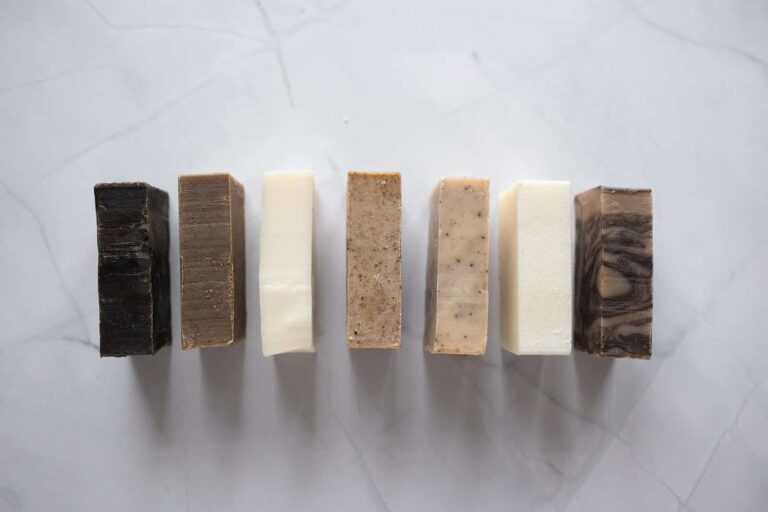
Whether it’s a deep-cleansing soap like our Sea Salt bar, a gently exfoliating soap like our Oatmeal and Honey Delight, or our Scent-Free, Color Free soap, you’ll find all our products will leave your skin feeling clean and hydrated.
Discover more from Fosters Homemade
Subscribe to get the latest posts sent to your email.